
Reviewed by Lee Gundenswager, Lead Electrician, Lic #92217 Last reviewed
How much does it cost to install an EV charger in Brisbane?
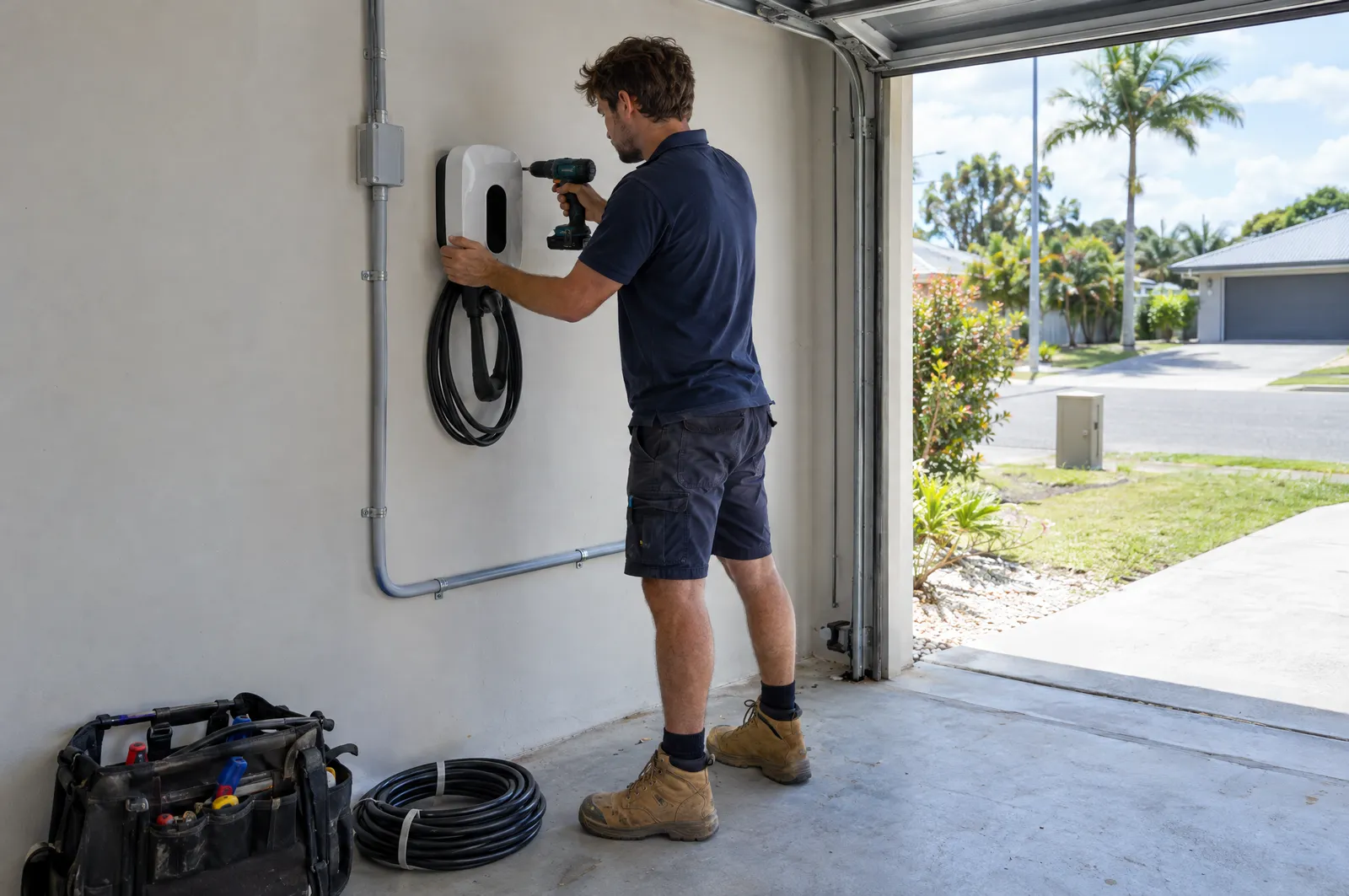
For a typical Brisbane house, the cost has two parts: the installation and the charger. Connex Electrical's standard single-phase installation is from $990 installed (inc GST). If you already own a charger, that may be the whole bill. If not, add the charger you choose. Everything else on this page explains the few things that change that number, so you can predict your own price before you call.
Price breakdown
| Cost item | Connex Electrical | When it applies |
|---|---|---|
| Standard single-phase install (7kW class) | From $990 installed (inc GST) | Most homes: charger in the garage or carport, reasonable distance from the board |
| Charger hardware | Your own, or supplied at a quoted price | Every job, unless you already have a charger |
| Extra cable run | Quoted from photos | Charger a long way from the switchboard, or a hard route |
| Switchboard upgrade | Quoted separately | Old fuses, no safety switches, or no room for a new circuit |
| Three-phase charger install | Quoted per job | Homes with three-phase supply and a car that accepts 11kW or 22kW AC |
| Pedestal mount or trenching | Quoted per job | No wall near the parking spot, or a detached garage or shed |
| Solar integration (CT sensor) | Quoted with the charger | Solar-aware chargers that follow your export |
What is included in the standard price?
- A dedicated circuit from your switchboard, with a correctly sized breaker and RCD protection
- Cable run within the standard allowance, clipped neatly or in conduit
- Mounting the charger on a wall or carport post
- Setup, Wi-Fi and app pairing where the charger supports it, and scheduling for off-peak times
- Testing, a test charge with your car, and your Certificate of Testing and Compliance
How much does the charger itself cost?
Charger prices vary with features more than with charging speed. A basic 7kW wallbox that simply charges when you plug in sits at the lower end. Units with app control, load management and solar-surplus charging (such as the myenergi Zappi or Fronius Wattpilot) cost more, and the Tesla Wall Connector sits in between. Third-party guides put Brisbane charger units at roughly $700 to $1,600. Our charger brand comparison covers what you get for the money.
What pushes the price up?
1. An older switchboard
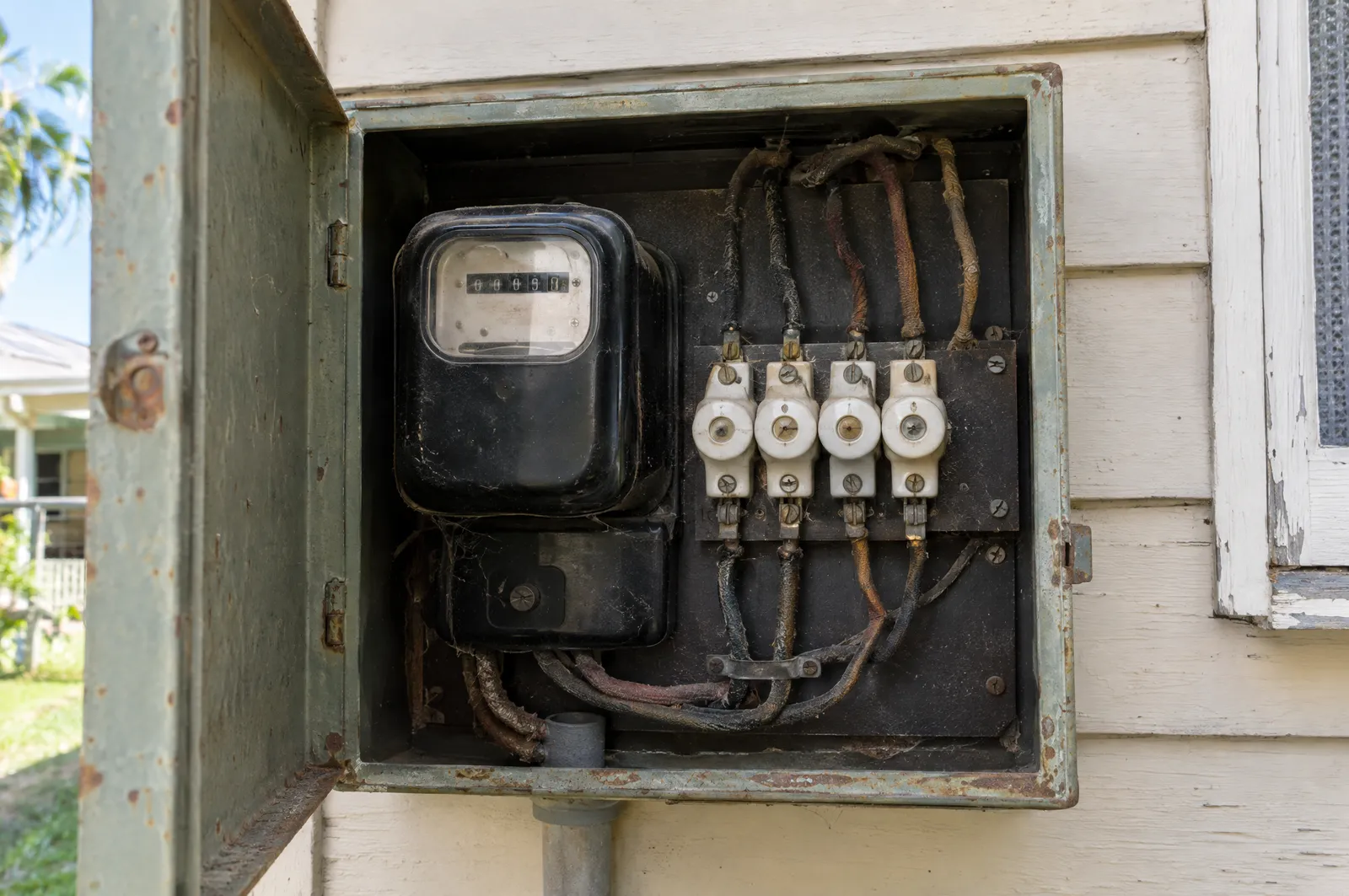
This is the single biggest variable. Boards with ceramic rewireable fuses, no safety switches or no spare space cannot safely take a new 32A circuit. Many pre-1990s Brisbane homes, especially Queenslanders and post-war houses that have never had a full upgrade, fall into this group. See switchboard upgrades for EV chargers.
2. Distance and route
A charger on the same wall as the board is the cheapest job. Every extra metre adds cable, and longer runs need thicker cable to limit voltage drop. Routes through a two-storey roof space, under a slab or across a driveway take more labour than a run under a high-set house.
3. Supply capacity
If your home already draws a lot at peak times (ducted air conditioning, a pool, an induction cooktop, a second fridge), the charger may need load management so it slows down when the house is busy. Most modern chargers can do this with a current sensor, and it is far cheaper than upgrading your supply.
4. Three-phase
A three-phase charger costs more to install and only pays off if your car can use the extra power. Most Brisbane homes have single-phase power. A single-phase 32A charger delivers up to about 7.4kW, which adds roughly 40 to 50 km of range per hour. A 22kW charger needs three-phase power and a car that can accept 22kW AC; many EVs are limited to 7kW or 11kW on AC.
5. Mounting and trenching
A pedestal in the middle of a driveway, or a charger in a detached shed, adds materials and labour compared with a garage wall.
How to keep the cost down
- Choose 7kW single phase unless you have a specific reason for more. It suits almost every household.
- Put the charger close to the board if the parking spot allows it.
- Send good photos of the switchboard, meter box and charger spot. It avoids a site-visit charge and gets you an accurate price.
- Plan for the future now. If a second EV is likely, size the cable for it during the first install.
- Charge smart. Use surplus solar or an off-peak tariff. Energex controlled-load tariffs (Tariff 31 and 33) run on a separate circuit with supply only during set hours, so they suit overnight charging but not daytime solar charging. A time-of-use plan on a smart meter is the usual alternative. Your retailer sets the actual rates.
How do competitor "from" prices compare?
Headline prices in Brisbane are hard to compare because each company includes different things. Here is how to read them:
| Advertised offer | What it usually includes | Watch for |
|---|---|---|
| EVSE residential install, $1,070 (seen October 2026) | Installation only, for chargers bought from EVSE, up to a 15 m run | The charger is extra; longer runs are extra |
| Very low "from" prices (under $800) | The simplest possible job | Cable length limits, board condition, charger lock-in |
| "Free installation" deals | Bundled with a charger or energy plan | Higher charger price or a plan contract |
| Connex Electrical: from $990 installed (inc GST) | Standard single-phase install, as listed above | Extras quoted in writing before you book |
Prices from other companies were taken from their public pages at the time of writing and may have changed. Always compare written quotes for the same scope.
Are there rebates that reduce the cost?
There is currently no Queensland Government rebate for home EV chargers. The state Zero Emission Vehicle rebate for cars closed on 2 September 2024 when its funding ran out. Occasional subsidised charger offers have appeared through federally funded trials, but they are limited and usually tie you to a specific charger and installer. We will tell you if one genuinely suits your home.
Do I have to pay Energex anything?
Not for a standard home charger. Energex rules for home EV chargers changed in October 2026, and we check the current requirements for your connection and lodge any notification Energex needs.
EV charger installation cost by area
What changes the price from suburb to suburb is mostly the typical home: older character homes are more likely to need a switchboard upgrade, apartments need body corporate approval, and acreage often means longer runs. Each suburb page explains what is typical locally.
- EV charger installation cost in Inner City (20 suburbs)
- EV charger installation cost in Northside (50 suburbs)
- EV charger installation cost in Southside (44 suburbs)
- EV charger installation cost in Eastern Suburbs (28 suburbs)
- EV charger installation cost in Western Suburbs (42 suburbs)
- EV charger installation cost in Moreton Bay (95 suburbs)
EV charger installation cost FAQs
What is the total cost of an EV charger including installation in Brisbane?
Add the charger to the install price. With Connex Electrical, a standard install is from $990 installed (inc GST), and home chargers themselves typically range from several hundred dollars for a basic unit to well over a thousand for solar-aware or premium models. Third-party industry guides put a typical Brisbane all-in total at roughly $1,300 to $2,300. Your fixed quote lists both parts separately.
Why do some companies advertise very low installation prices?
Low "from" prices usually cover only the simplest job: a short cable run, a modern board with spare room, and sometimes only if you buy their charger. EVSE, for example, advertises its residential install at $1,070 but it applies to chargers bought from EVSE and covers a run of up to 15 metres. Always ask what is excluded before comparing.
How much does a switchboard upgrade add?
Only some homes need one. If your board has old ceramic fuses, no safety switches or no room for a new circuit, an upgrade is usually needed first. Industry guides quote roughly $800 to $3,000 for a residential upgrade depending on the scope. We quote it separately so you can see exactly what it covers before deciding.
Is there a Queensland rebate for home EV chargers?
Not at the moment. There is currently no Queensland Government rebate for home EV chargers. The state Zero Emission Vehicle rebate for cars closed on 2 September 2024 when its funding ran out. Occasionally a retailer or federally funded trial offers a subsidised charger, and if one fits your situation we will tell you. Be wary of "free installation" offers that lock you into a particular charger or energy plan.
What if my garage is a long way from the switchboard?
A longer cable run is common and is simply priced into your quote. The cable size goes up with distance to keep voltage drop in check, and the route might go through the roof space, under the house or along an external wall in conduit. Sending photos of the switchboard and the charger spot helps us price it accurately without a visit.
Should I get a 7kW or 22kW charger?
For most homes, 7kW is the right choice. It works on single-phase power and fully charges most EVs overnight. A 22kW charger needs three-phase supply and only charges faster if your car supports 22kW AC, which many models do not; several are capped at 7kW or 11kW. Spending extra on 22kW rarely pays off for a single household car.
Can you install a charger I have already bought?
Yes. We install chargers bought elsewhere, including units from car dealers and online stores, as long as they are approved for sale in Australia. Send us the model when you request a quote so we can check its requirements, cable sizing and any network settings before we arrive.
How much will charging add to my power bill?
It depends on how far you drive and when you charge. A typical EV uses roughly 15 to 20 kWh per 100 km, so multiply your weekly distance by that and by your tariff rate. Charging on surplus solar or an off-peak rate keeps the cost well below the price of petrol for the same distance. Check your retailer for current rates.
Sources: third-party price ranges from Gridly (gridly.com.au) and Whats The Damage (whatsthedamage.com.au); EVSE offer from evse.com.au; rebate status from the Queensland Government (qld.gov.au). Checked October 2026.