
Reviewed by Lee Gundenswager, Lead Electrician, Lic #92217 Last reviewed
What does a home EV charger installation involve?
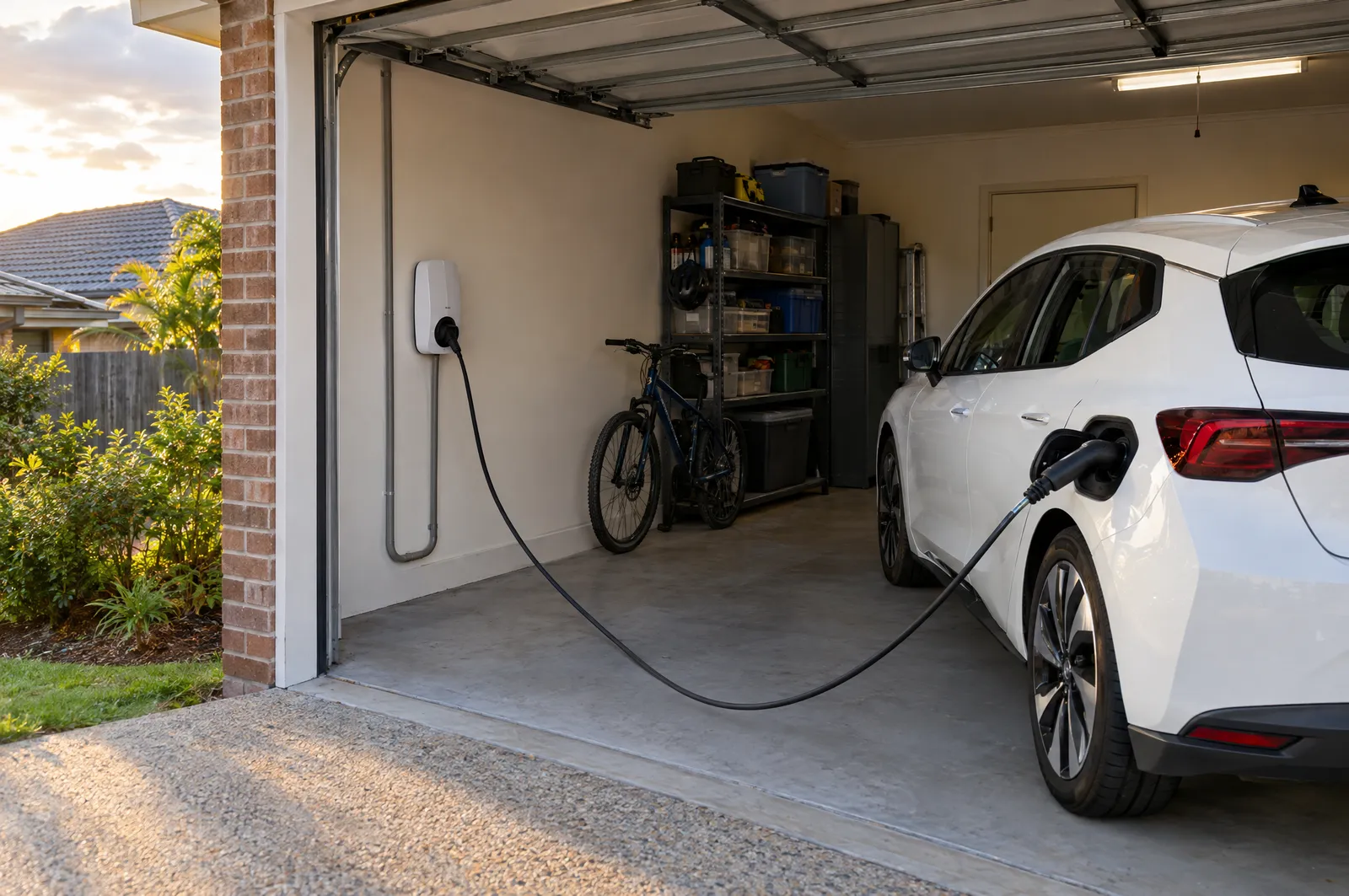
A home charger, often called a wallbox, is a fixed unit wired on its own circuit from your switchboard. It charges several times faster than the portable cable that came with your car, it is built for hours of continuous load every night, and it lets you schedule charging for cheaper times. Installation means running a new circuit with the right protection, mounting the charger where your cable reaches the charge port comfortably, setting it up and testing it with your car.
Which charger suits your home?
| Your situation | What we usually recommend |
|---|---|
| One EV, overnight charging, single-phase house | A 7kW single-phase wallbox |
| Rooftop solar and the car is often home by day | A solar-aware charger such as a Zappi or Wattpilot (solar EV charging) |
| Tesla owner | Tesla Wall Connector, which also charges other EVs (Tesla install) |
| Two EVs, or one coming soon | Two load-sharing chargers, or one charger with the cable sized for a second |
| Three-phase supply and a car that accepts 11kW or more | An 11kW or 22kW three-phase charger |
| Busy household supply (ducted air, pool, induction) | Any charger with load management and a current sensor |
Garage, carport or driveway?
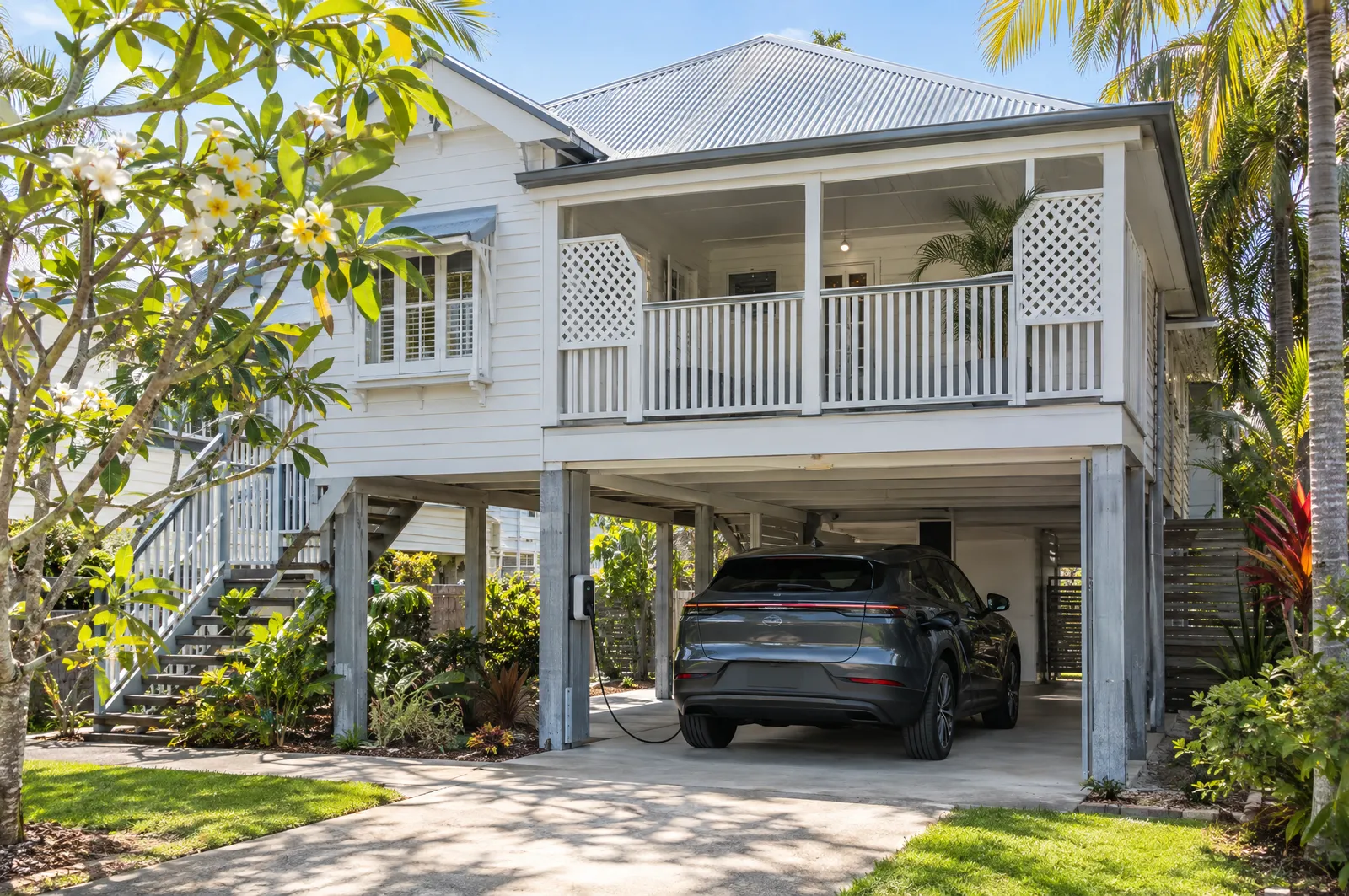
Garage walls are ideal: sheltered, close to the car and often near the meter box in houses built since the 1990s. Carports work well with a charger on a post or rear wall; most wallboxes are rated for outdoor use. Under a high-set Queenslander, the space beneath the floor usually makes the cable run easy. Driveways with no nearby wall can use a pedestal mount. We position the charger so the cable reaches the port without crossing a walkway or stretching.
Single phase or three phase?
Most Brisbane homes have single-phase power. A single-phase 32A charger delivers up to about 7.4kW, which adds roughly 40 to 50 km of range per hour. A 22kW charger needs three-phase power and a car that can accept 22kW AC; many EVs are limited to 7kW or 11kW on AC.
Will my switchboard need an upgrade?
Most homes built from the 1990s onwards have boards that can take a charger circuit as they are. Older homes with ceramic fuses, no safety switches or no spare space usually need a switchboard upgrade first. We check from photos or on a short site visit and quote any upgrade separately.
Townhouses and body corporate homes
In a townhouse complex, check whether the charger or its cable would touch common property, such as a shared garage wall or a run through the complex. If it does, you need body corporate approval. In Queensland, installing a charger on common property needs body corporate approval, and bodies corporate can make by-laws covering EV charging, metering and billing. We can prepare a short scope of works for the committee. For whole-building charging, see commercial and body corporate charging.
Energex, rebates and paperwork
Energex rules for home EV chargers changed in October 2026, and we check the current requirements for your connection and lodge any notification Energex needs. There is currently no Queensland Government rebate for home EV chargers. The state Zero Emission Vehicle rebate for cars closed on 2 September 2024 when its funding ran out. Queensland electrical contractors must give you a Certificate of Testing and Compliance for the work, and keep a copy for five years.
From quote to first charge
- Step 1
Request a quote
Use the form or call us. Photos of the meter box and garage speed things up.
- Step 2
We confirm the details
Supply capacity, cable route and any Energex requirements are checked before we book.
- Step 3
We install
Circuit, protection and charger, usually done in 2 to 4 hours.
- Step 4
You start charging
We commission the charger with your car and leave you with your Certificate of Testing and Compliance.
Home EV charger FAQs
Do I need three-phase power to charge an EV at home?
No. Most Brisbane homes are single phase, and a single-phase 32A charger delivers up to about 7.4kW, enough to refill a typical daily commute in two or three hours overnight. Three-phase only helps if your car can accept 11kW or 22kW on AC and you regularly need fast top-ups at home. We can tell you which applies to your car.
Can I just charge from a normal power point?
You can, but it is slow. A standard 10A power point with the portable cable that came with the car adds roughly 10 to 15 km of range per hour, which may suit a short commute. A dedicated wallbox is several times faster, safer for long daily sessions and lets you schedule charging for cheaper tariff periods.
Can an EV charger be installed outside?
Yes. Most wallboxes are rated for outdoor use, so a carport post or external wall is fine. We still look at placement: out of direct afternoon sun where possible, clear of where water pools, and where the cable reaches the charge port without stretching across a path. A pedestal mount works where there is no wall nearby.
Can I charge two EVs at home?
Yes. You can fit two chargers that share the available power, or one charger and plan charging times. Many chargers support load sharing, so both cars charge overnight without overloading your supply. If you expect a second EV soon, mention it at quoting so we size the circuit and cable for it now and save a second callout later.
I am renting. Can I still get a charger installed?
Yes, with your landlord or agent agreeing in writing first. A wallbox is a fixed electrical installation, so the owner must approve it. Many landlords say yes because it adds value to the property. We can give you a quote and a short scope of works to send to your property manager.
Does the Queensland heat affect home charging?
A little. Chargers and cars can reduce charging speed when they get very hot, so a spot out of direct western sun is better for both the charger and the cable. A garage wall or shaded carport post is ideal. Charging overnight, when most people charge anyway, avoids the hottest part of the day entirely.
What warranty do I get?
The charger carries the manufacturer's warranty, which varies by brand and is usually several years. Our workmanship is guaranteed too, and because we are a local Brisbane contractor rather than a call centre, you deal with the same team if anything needs attention. We will confirm the exact warranty terms for your charger in writing with the quote.
Looking for your suburb? See all the areas we cover or the full cost guide.